Sham’ election in Tanzania fuels open revolt against president Samia
 October 31, 2025
4 min read
October 31, 2025
4 min read
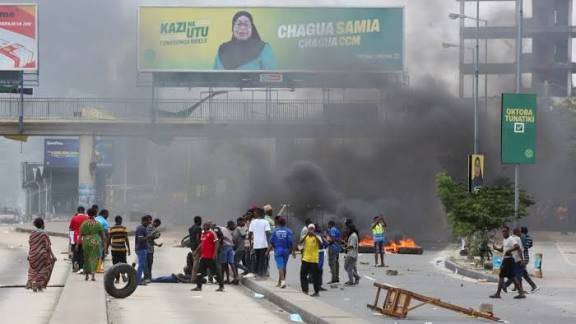
Demonstrators in Dar es Salaam attend to a man shot during violent protests that marred the election © Onsase Ochando/REUTERS
In Tanzania, an internet blackout and a newly imposed curfew failed to stop demonstrators from challenging an election they see as predetermined, sparking the most significant unrest the country has seen in decades.
Tanzania is facing mounting political uncertainty after protests erupted across major cities following Wednesday’s elections, which were marred by arrests, internet shutdowns and widespread reports of voter apathy.
In the commercial capital, Dar es Salaam, hundreds of demonstrators, many of them young Tanzanians, defied police orders and marched through the city centre chanting: “We want our country back!” and “We demand a new independent electoral commission!” Smaller protests were reported in Arusha, Mwanza and Mbeya, as frustration boiled over at what many called a “sham election”.
President Samia Suluhu Hassan is widely expected to be declared the winner after running virtually unopposed. Her main challenger, Tundu Lissu of the opposition Chadema party, remains in jail facing treason charges for calling for electoral reforms, while former cabinet minister Luhaga Mpina was barred by the electoral commission from contesting.
That left Samia competing against 16 minor parties, prompting critics to dismiss the vote as pre-determined.
Empty Polling Stations and Street Anger
Turnout on election day was visibly low, with many polling centres in Dar es Salaam deserted, according to observers. “We want this sham election nullified. We want a transitional government to organise a fresh poll,” one protester said.
As protests spread, police imposed a curfew and an internet blackout across much of the country. “Everyone should be at home from 6pm. Only the police and army will patrol the streets of Dar es Salaam for special assignment,” the national police chief, Camillus Wambura, announced on state broadcaster TBC.
Despite the restrictions, witnesses say pockets of demonstrations continued late into Wednesday night in Dar es Salaam and on Thursday in Arusha.
A local journalist, speaking on condition of anonymity, said newsrooms are operating under fear. “We are in darkness. We don’t know what is happening. We are just at home waiting,” he said, noting that most media outlets were avoiding coverage of the unrest to escape government sanctions.
The government has ordered all public servants to work from home on Thursday over “security concerns”. Spokesperson Gerson Msigwa announced that only essential staff should report physically to their offices.
The unrest, while unlikely to derail Samia’s expected victory, underscores mounting public frustration with Tanzania’s restrictive political environment, analysts say.
“The heavy-handed response by security forces is driven by government paranoia and a determination to deny the opposition any opening,” said political economist Jervin Naidoo.
He warns that “given the curfew and heightened tensions, businesses and investors with interests in Tanzania and Zanzibar should remain vigilant throughout the post-election period.”
Regional Solidarity and Condemnation
Events in Tanzania have drawn attention and support from activists and opposition leaders across East Africa.
Ugandan opposition figure Robert Kyagulanyi (Bobi Wine) said on X: “The young people of Africa are speaking. I stand in solidarity with the great people of Tanzania who are defying odds to protest against electoral injustice and impunity.”
In neighbouring Kenya, opposition MP Caleb Amisi voiced similar sentiments, saying he stands “with Tanzania’s Gen Z in their quest to restore constitutional democracy”.
Amnesty International condemned police for using excessive force, reporting that two protesters were killed and several others injured after officers opened fire in Dar es Salaam.
‘A Wind of Change is Coming’
Analysts say the unrest signals a deeper legitimacy crisis for the ruling Chama Cha Mapinduzi (CCM) party, which has governed Tanzania since independence.
Political analyst Brian Wanyama says that Samia now faces “an uphill task to unite the country” once results are formally announced.
“She has the best opportunity to reconcile with opponents. Freeing Tundu Lissu would be a powerful start,” he says. “The protests show just how much anger has been simmering beneath the surface.”
Kenyan governance expert Alenga Torosterdt describes the demonstrations as “a warning shot” to Tanzania’s long-dominant ruling party.
“What is happening shows the wind of change is coming. You cannot suppress people forever,” he says.
Since the return of multiparty politics in 1992, Tanzania has prided itself on political stability and gradual reform rather than upheaval. This unrest marks the first time in more than three decades that nationwide protests have erupted on election day.
For a generation raised online and inspired by youth-led movements in Kenya and Uganda, analysts say the protests represent more than frustration with one election; they are a rejection of a political system many see as closed and unaccountable.

Related Articles