Lessons Kenya can learn from Morocco’s Football Revolution
 October 21, 2025
8 min read
October 21, 2025
8 min read
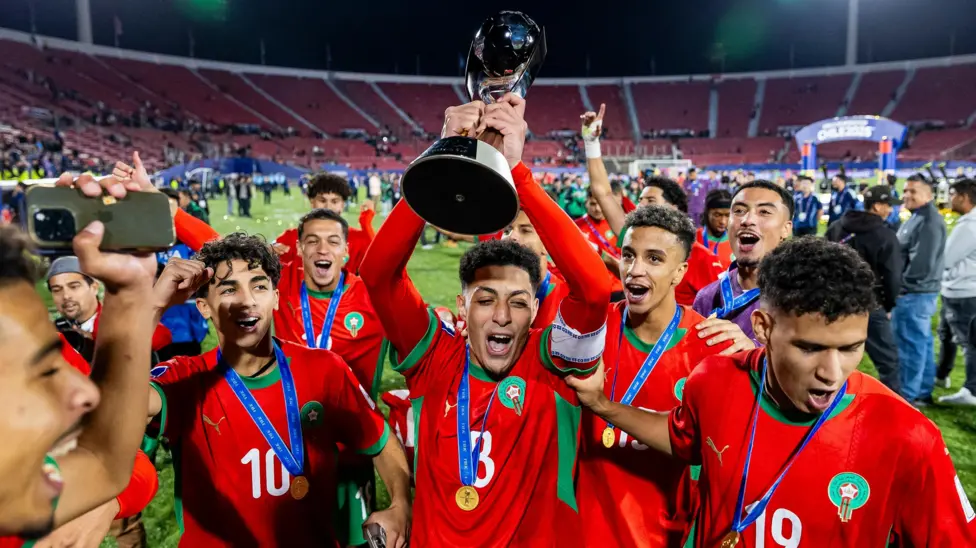
Morocco u-20 players celebrating after winning the u-20 FIFA World Cup in Chile beating Argentina 2-0/ Photo Courtesy
When Morocco’s u-20 team overcame record six-time champions Argentina 2-0 to lift the FIFA u-20 World Cup trophy in Chile on Sunday, it wasn’t just another African victory. It was the final stamp of a plan that started quietly more than a decade ago — one that has turned the North African nation into a genuine global football force.
Striker Yassir Zabiri scored both goals making Morocco just the second African nation to lift the trophy, emulating Ghana in 2009.
From finishing fourth at the 2022 FIFA World Cup in Qatar to winning a world title at youth level and preparing to co-host the 2030 edition alongside Spain and Portugal, Morocco’s rise has been anything but accidental. It’s a story of long-term vision, investment in people, and a football federation that thought beyond the next tournament.
The beginning: When Morocco pressed the reset button
The rise of Moroccan football has been a long-term project for King Mohammed VI and the Royal Moroccan Football Federation (FRMF).
The king first discussed his plan to use football as a tool for social and economic development in 2008, before opening an academy in 2009 and a $65m (Ksh8.4B) training facility near the capital Rabat in 2019 – both of which bear his name (the Mohammed VI Football Academy).
Five of the players who started the u-20 World Cup final attended the academy, as did the likes of Marseille centre-back Nayef Aguerd, Girona midfielder Azzedine Ounahi and Fenerbahce striker Youssef En-Nesyri – all of whom played a part in the Atlas Lions’ historic run to the semi-finals of the 2022 FIFA World Cup in Qatar.
“We can’t overlook the major role played by the Mohammed VI Football Academy, a pioneer in this field, where they’ve done remarkable work with young players,” Fathi Jamal, the director of technical development at the FRMF, told Fifa.com.
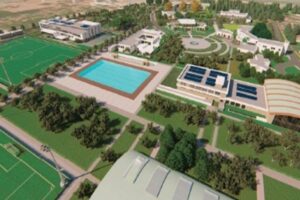
The training facility boasts eight full-size pitches, gym and medical facilities, an Olympic-sized swimming pool and a 5-star hotel among its amenities. Meanwhile, the federation has set up its own regional training centers, invested in 7,000 amateur pitches, and looked to modernize its technical staff, emphasizing the importance of training local coaches.
Vast sums have also been spent on redeveloping and building stadiums to stage the 2025 AFCON and co-host the 2030 FIFA World Cup (together with Spain and Portugal) – with the total costs reported as $5bn (Ksh647bn).
The year was 2014, and Morocco’s football was at a crossroads. The Atlas Lions had failed to qualify for multiple World Cups, and local football structures were in disarray. Instead of pointing fingers, the FRMF went back to the drawing board.
With strong backing from King Mohammed VI, Morocco launched a bold national football development plan. It wasn’t glamorous — but it was deliberate. They began by building the Mohammed VI Football Academy, a state-of-the-art complex designed to identify and nurture young players with the technical and tactical grounding to compete internationally.
Building the engine: coaches, continuity and culture
While the academy grabbed headlines, Morocco’s real secret weapon was coaching continuity. The federation poured resources into training local coaches, ensuring every youth and senior team shared the same playing philosophy — quick passing, tactical discipline, and collective pressing.
By the time Walid Regragui led Morocco to their famous semi-final run in Qatar 2022, the national team’s style wasn’t imported; it was homegrown. The players understood each other because they had grown through the same system.
The federation also resisted the temptation to change coaches after every bad result — a habit that continues to derail many African nations, Kenya included. Regragui and his staff were backed with long-term contracts, data analysts, sports scientists, and consistent funding.
It’s this combination — patience and planning — that has turned Morocco into Africa’s most organized football ecosystem.
Infrastructure: Stadiums that fuel ambition
Another part of Morocco’s success has been infrastructure.
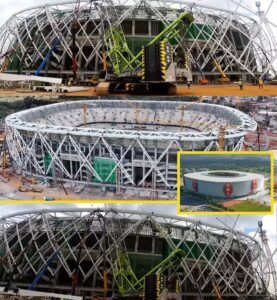
In preparation for the 2030 global showpiece that will include a possible 64 teams, the country has broken ground on the 115,000-seater Grand Stade de Casablanca, set to be among the largest in the world. Several other stadiums — in Marrakesh, Agadir, Tangier, and Rabat — have been upgraded to CAF and FIFA standards.
But Morocco’s stadium revolution didn’t start yesterday. The FRMF and government realized early that quality venues attract major tournaments, and major tournaments attract money. Hosting CAF competitions, international youth tournaments (both men and women), and now a World Cup isn’t just about prestige; it’s an economic strategy.
Morocco’s lesson here is simple: build few, but build well. A handful of world-class stadiums can transform a football nation faster than a dozen empty shells.
The 2022 World Cup: Africa’s dream realized
When Morocco lined up against Croatia in the third-place playoff at the 2022 FIFA World Cup, millions of Africans watched with pride. Here was a team that had eliminated Spain and Portugal playing fearless football.
That run changed global perceptions about African teams. It proved that tactical organization and mental discipline can bridge the gap with Europe and South America. It also inspired a new generation of African coaches and players to dream bigger.
After the historic achievement head coach Walid Regragui was a stern believer that a team from the continent will win the quadrennial football tournament in the next 10-15 years.
“We have a stage to get past. We need to build on that, with hard work and desire. This DNA is not just being built for Morocco, but for the continent,” he said.
The recent u-20 triumph
Fast-forward to 2025, and Morocco’s u-20 World Cup victory completes the circle. The young players who celebrated in Jakarta last weekend are products of that same academy system launched in 2009. It’s the clearest proof yet that sustained investment in youth pays off.
The FRMF didn’t just throw money around — they built a structure that works. They linked schools to academies, academies to local clubs, and local clubs to the national teams. There’s now a visible football ladder that every Moroccan youngster can climb.
This World Cup title follows the remarkable rise of Moroccan football: the senior team’s 2022 World Cup semifinal, the U23 AFCON victory, three times CHAN champions (2018, 2020 and 2024), and strong performances by the U17 and women’s national teams. All of these successes share one root — the royal vision and investment in training and infrastructure, embodied by the Mohammed VI Academy.
Even the head coach Mohamed Ouahbi emphasized: “This title is the result of years of structured work — a clear example of Morocco’s belief in its own youth and local talent.”
What Kenya can borrow from Morocco
Start with youth academies, not senior teams. Kenya needs to stop chasing quick fixes. A national academy system — even starting with just two well-run regional centers — can become the seedbed for the future Harambee Stars. The main focus for King was on youth development.
Empowering local coaches is another step towards glory. CAF coaching licenses should be subsidized and tied to performance. Our ex-players and retiring ones be part of a generation of technically educated coaches. Additionally, coaches should be given time and full support to integrate their ideologies to the teams.
Government and FKF partnership. Morocco’s federation worked hand in hand with government ministries and private investors. Kenya must end the tug-of-war between the Ministry of Sports and FKF. Football needs cooperation, not confrontation.
Focus on three main stadiums to lay the foundations of future success. Kenya is currently constructing the Talanta Stadium in readiness of AFCON 2027, add that to the newly refurbished Kasarani and Nyayo and you have a foundation. The two existing stadia should not incur closures every now and then for upgrades, it’s time for them to reach CAF and FIFA standards once and for all.
Finally, host and learn. Morocco’s hosting of AFCON tournaments, CHAN, and soon the World Cup created jobs, unity, and pride. The recently hosted CHAN24 was a testament that Kenya can and should host continental tourneys. The August tournament- won by Morocco- should be a lesson for the government and FKF to improve on ticketing system, and planning and executing the tournament- a major concern by CAF.
The long game
Football progress is rarely dramatic; it’s usually gradual. Morocco’s transformation from mediocrity to global respect took more than a decade of persistence, planning, and patience. Kenya, too, can get there — but only if the focus shifts from quick fixes to long-term systems.
It begins with a simple question: what kind of football nation do we want to be in 2035 and beyond?
If we want a Morocco-style story, then the time to start building is now — in classrooms, dusty pitches, and coaching workshops, not just in ministerial press conferences.
Morocco didn’t wait for miracles. They built their own. Kenya can do the same.

Related Articles